Woundwood Formation
Tree Response to Proper Pruning Cuts
Woundwood formation is a biological response to proper pruning cuts rather than simply a sign of tree healing. When a pruning cut is made outside the branch collar, the tree begins forming woundwood tissue that gradually grows over the exposed surface.
This woundwood develops from the cambium surrounding the cut and slowly forms rib-like rolls of new tissue that expand inward over time. The process is part of the tree’s Compartmentalization of Decay in Trees (CODIT) defense system, which isolates injured wood and limits the spread of decay.
In some cases, epicormic sprouts may develop near the woundwood ribs. These sprouts can provide localized, short-term supplemental photosynthesis that helps supply energy to the surrounding tissues while compartmentalization and wound closure are occurring.
Over time, healthy woundwood formation can completely seal the pruning cut, restoring structural continuity and protecting the interior wood from decay organisms.
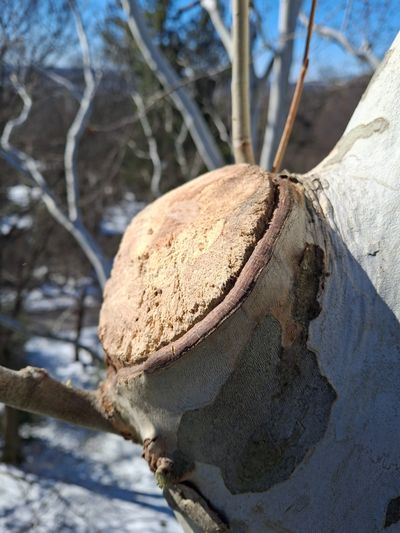
Woundwood forming around a pruning cut on a mature American sycamore (Platanus occidentalis)
Red Maple Woundwood Response
Corrective Stub Cut Supporting Compartmentalization
A mature red maple (Acer rubrum) showing woundwood formation following a corrective pruning cut used to remove a previously retained stub. Eliminating the stub allows the tree to continue the compartmentalization process described in the CODIT model.
The ribbed woundwood tissue visible along the margin of the cut indicates active growth from the surrounding cambium as the tree gradually closes the wound and isolates injured wood.
This observation was documented in the Collingwood neighborhood of Alexandria, Virginia as part of the Fort Hunt Tree Observatory Project, which records structural responses, pruning outcomes, and decay processes in mature urban trees.

Woundwood forming on a red maple after corrective removal of a pruning stub. Alexandria, Virginia