TREE RISK ASSESSMENT
TREE RISK ASSESSMENT
Tree risk assessment is the process of evaluating the likelihood of tree failure and the potential consequences associated with that failure. In urban environments such as Fort Hunt and Alexandria, Virginia, this involves understanding how structural defects, biological conditions, and environmental forces interact over time. Tree failure is rarely caused by a single issue; rather, it is typically the result of multiple contributing factors acting together under specific loading conditions such as wind, saturated soil, or canopy imbalance.
WHAT IS TREE RISK?
Tree risk is generally defined by two primary components: the likelihood of failure and the consequences of that failure. The likelihood of failure refers to the probability that a tree, or part of a tree, will fail. The consequences of failure relate to what the tree could impact if failure occurs. These two factors must always be considered together. A structurally compromised tree located in a low-target area may present less overall risk than a moderately defective tree positioned over a home, driveway, or pedestrian space.
STRUCTURAL & BIOLOGICAL DYNAMICS
Structural and biological dynamics play a central role in how tree risk develops. Common structural conditions include co-dominant stems with included bark, poor branch attachment angles, cracks or splits within the trunk, and internal decay affecting load-bearing wood. Biological and physiological factors include crown dieback, reduced vigor, decay organisms degrading structural integrity, compartmentalization processes within the tree, and root system decline. These conditions often progress gradually and may not be externally visible until structural integrity has already been significantly reduced.
ENVIRONMENTAL & LOAD FACTORS
Trees do not fail in isolation; they fail under load. Environmental and site-related factors are critical in determining when and how failure occurs. Wind loading, canopy sail effect, saturated soils, asymmetrical crown weight distribution, and previous pruning or storm damage all contribute to the forces acting on a tree. A tree that appears stable under calm conditions may be operating near its structural limits during storm events or periods of increased environmental stress.
TARGET & SITE CONTEXT
Risk is also influenced by what the tree can impact. Common targets include residential structures, vehicles, walkways, and occupied outdoor spaces. Site conditions such as soil type, drainage, slope, and surrounding vegetation further influence how forces are distributed and how a tree may respond under load. Understanding both the tree and its surrounding environment is essential when evaluating overall risk.
FIELD OBSERVATION & ASSESSMENT
Tree risk assessment is based on systematic field observation and interpretation of visible conditions. This includes evaluating crown condition and canopy density, identifying structural defects along the trunk and branch unions, assessing the root flare and basal condition, and noting any evidence of decay, insect activity, or fungal presence. Observations are made based on conditions present at the time of inspection and may be supplemented by additional diagnostic methods when appropriate.
RISK IS DYNAMIC
Tree risk is not static; it changes over time. Seasonal growth, weather events, ongoing decay progression, and changes in site use can all influence risk levels. A tree that appears acceptable at one point in time may present increased risk under different environmental conditions or as defects progress.
APPLICATION IN RESIDENTIAL LANDSCAPES
In Fort Hunt and surrounding Alexandria neighborhoods, tree risk assessment is commonly used to identify structural defects before failure occurs, evaluate declining or stressed trees, and guide decisions related to pruning, mitigation, or removal. Understanding the underlying dynamics of tree failure allows for more informed and effective tree management.
PROFESSIONAL SERVICES & CASE STUDIES
For site-specific tree risk assessment, maintenance recommendations, or professional tree care services in Fort Hunt and surrounding Alexandria neighborhoods, consultation with an ISA Certified Arborist is recommended.
View related service-based case studies and field applications:
Tree Risk Case Studies – Fort Hunt & Alexandria VA
DISCLAIMER
This content is intended for educational and informational purposes and reflects general principles of tree risk assessment based on field observation. Individual tree conditions vary and should be evaluated on a site-specific basis.
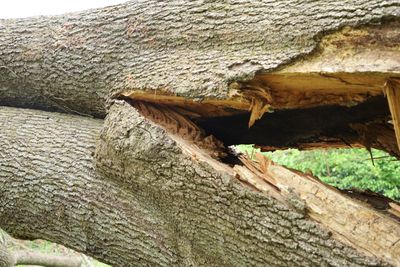
Included bark failure at a co-dominant union demonstrating structural weakness and separation risk